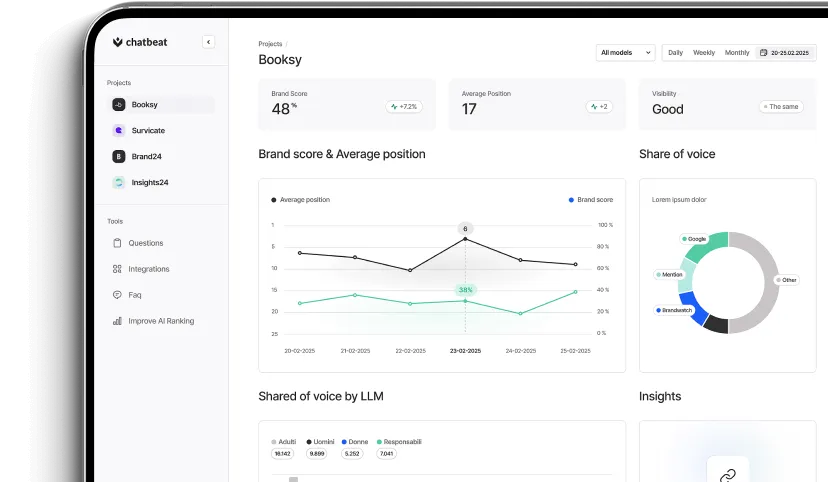
Results at a glance
- Stronger overall AI visibility: Brand Score 50% → 65% in ~2 months
- Better placement in AI answers: average position 8 → 5; median position 6 → 3
- Competitive jump: moved from #4 to #2 among competitors
- AI visibility → real traffic: website sessions from Gemini up 12×; from Copilot up 60×
- Overall AI traffic: 48,6% increase
About Base
Base is an e-commerce sales management platform trusted by over 30,000 companies to power their global operations. Designed for teams selling across multiple channels, it centralizes order processing, product management, marketplace listings, shipping, and automation into a single interface.
The platform further optimizes workflows with specialized tools for analytics, WMS, PIM, repricing, and AI, while offering an expansive ecosystem of 1,700+ integrations – including major marketplaces, online stores, accounting software, and carriers.
Featured in this case study:
Karina Kondraciuk – Senior SEO Specialist at Base. She leads the brand’s organic visibility strategy, leveraging her extensive background in SEO across e-commerce and service sectors. Currently, she connects technical optimization with content strategy, expanding the brand’s reach into AI search via Generative Engine Optimization (GEO).
Challenge
When AI started dominating the conversation, the Base team treated it as a new customer acquisition channel – but the motivation wasn’t only performance-driven.
They also had a very “brand” goal: prove that AI models see them as an authority and actually use their content as a trusted source.
They started working on AI visibility in May 2025, with two core challenges in mind:
- Understand AI user intent: what people really ask in AI tools – and which questions Base wants to be the default answer for.
- Stop operating in the dark: without hard data, it’s almost impossible to tell whether content updates and onsite improvements are actually changing visibility in model answers.
"Biggest Chatbeat's benefit is that we're no longer guessing. We can actually see the impact of what we're doing. Just like in SEO or paid campaigns, you need proof it's working – you can't operate "in the dark." Chatbeat lets us check whether we're showing up in AI answers and whether the metrics are growing."
.webp)
Strategy
1. Monitor & diagnose – “Are we visible to LLMs at all?”
They started with a baseline, not assumptions:
- Verified whether the site is accessible to LLMs and whether the content is actually visible
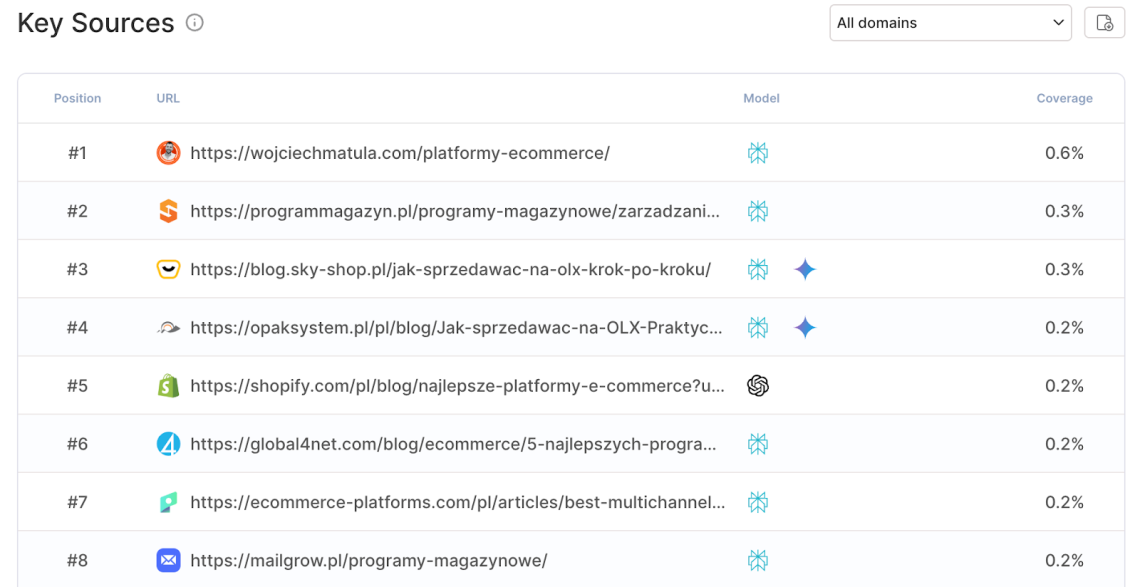
- Checked whether they show up in AI answers and in sources, and how that compares to competitors.
Where Chatbeat fit: one dashboard + the Sources view to confirm: do we appear, who appears instead, and are the metrics trending up.
2. Map prompts – from broad questions to product-driven branches
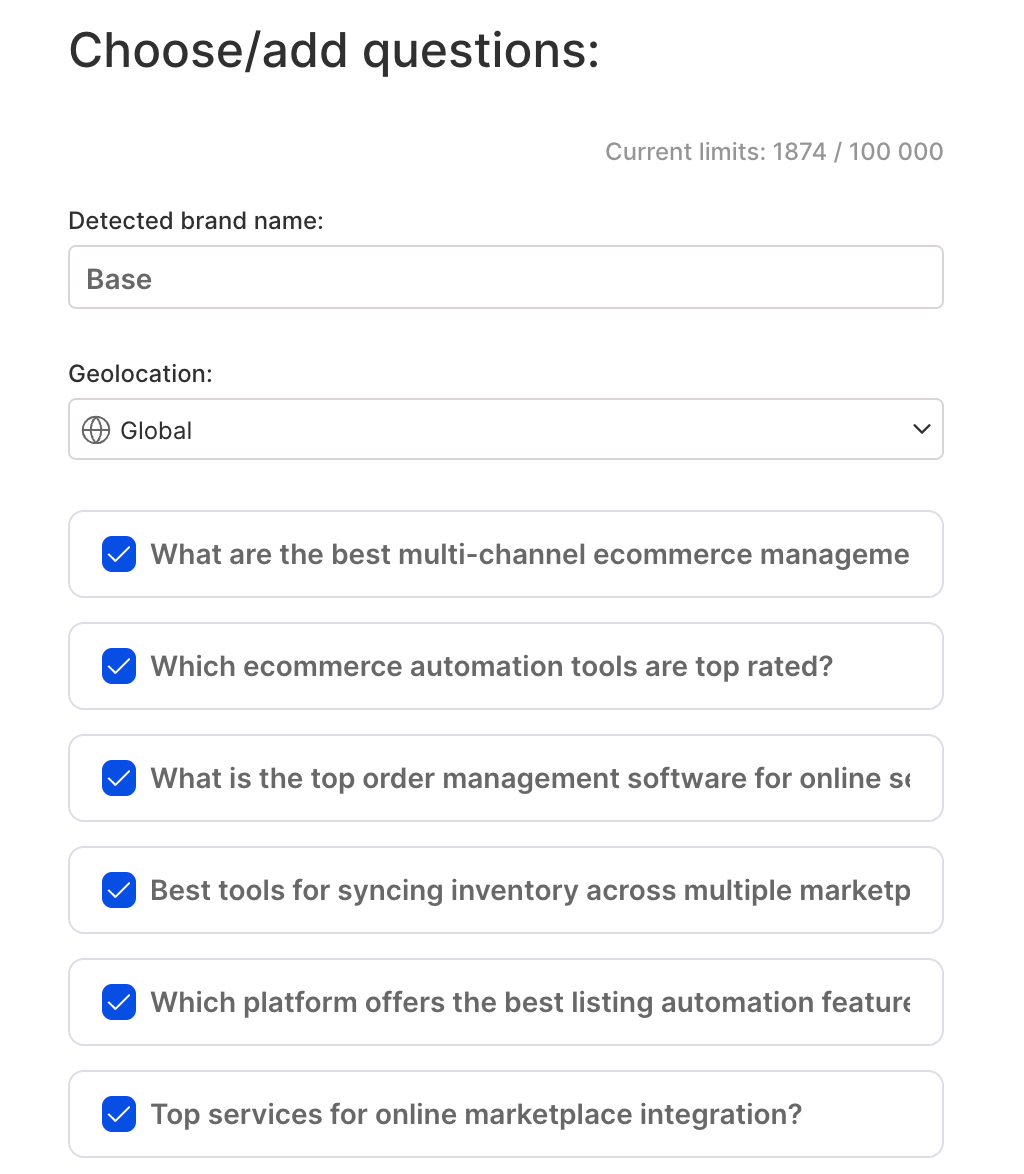
The early challenge was twofold: what users really ask and which questions they want to win. Their process:
- Started with broad category prompts like “which e-commerce management system should I choose?”
- Broke them into topic branches
- Built prompt sets around their product’s functions, so monitoring aligned with what they could credibly answer.
Where Chatbeat fit: suggested prompts were a major accelerator when finding the right prompts was difficult.
"Chatbeat's prompt suggestions helped us a lot. Finding the right prompts was hard, and your recommendations made it much easier."
3. Optimize for “citable authority” – content, formats, and credibility
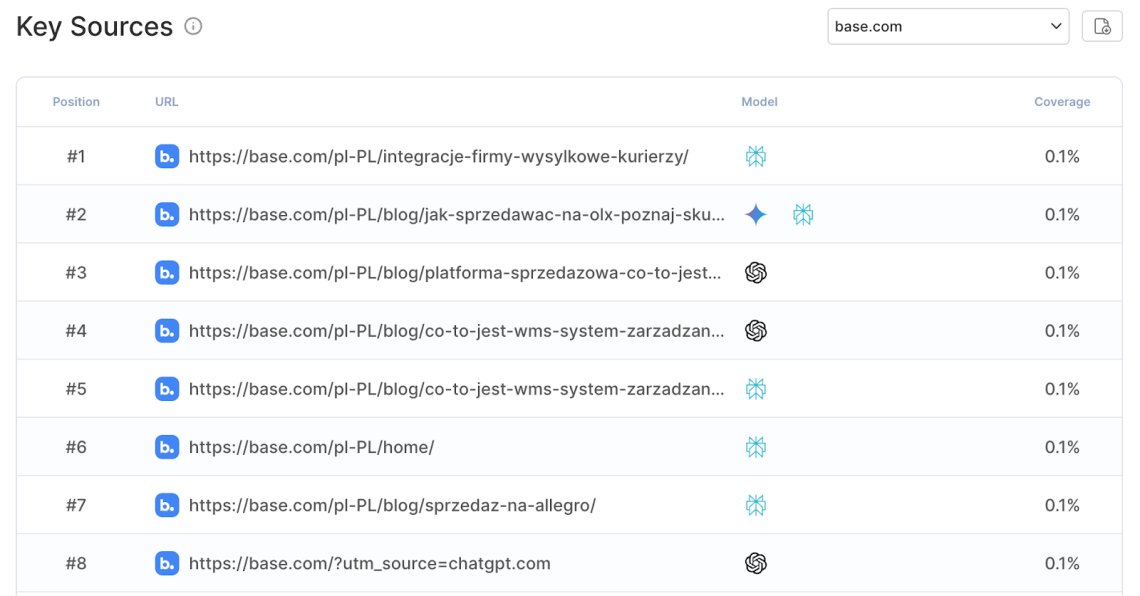
They identified the biggest lever as how content is written and made it easier for models to trust and reuse:
Where Chatbeat fit: visibility + sources monitoring became the feedback loop for iteration.
"With Chatbeat, we noticed that the prompts we monitor often include rankings and comparisons. So we added more of that kind of content to our strategy – and we're planning even more."
Results
1. Stronger overall AI visibility
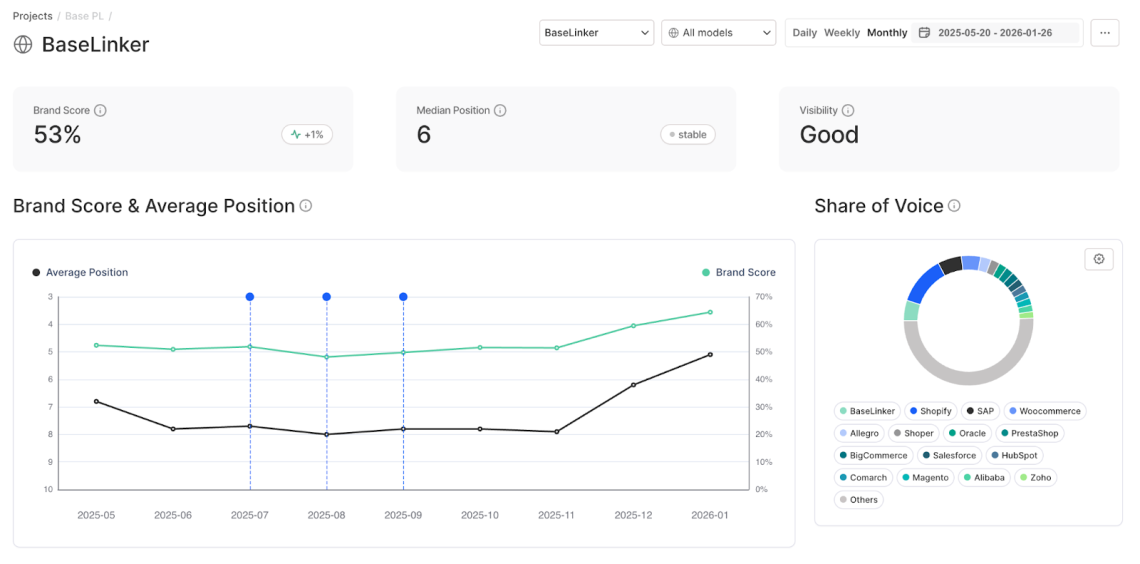
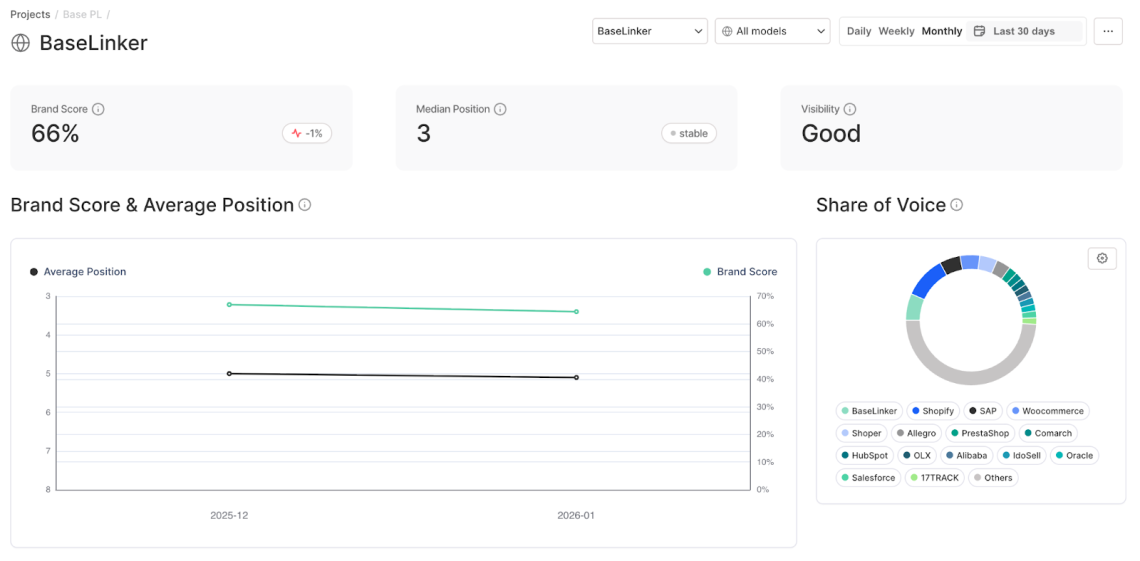
Base achieved a clear uplift in AI visibility across monitored models (as of Jan 26, 2026)
- Brand Score: 50% → 65% in ~2 months
- Average position in LLM answers: 8 → 5
- Median position: 3 (up from 6 in October)
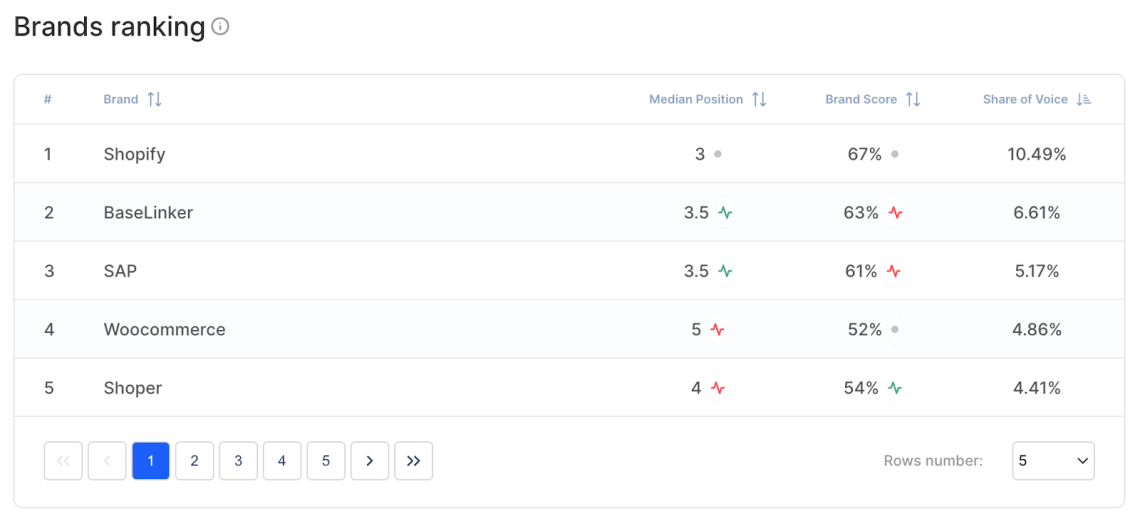
2. Competitive leap
Base moved from a steady #4 position (pre-December) to #2 among competitors in the last 30 days – turning AI visibility into a real competitive advantage, not just incremental progress.
3. Visibility → traffic (real sessions, not vanity metrics)
The growth wasn’t limited to “scores” inside tools – it translated into site visits from AI platforms:
- Gemini: 12× more sessions (May → December)
- Copilot: 60× more sessions (May → December)
- Overall AI traffic: 48,6% higher at the November peak vs. May
Takeaway for other brands
We asked Karina what other brands can do to replicate Base’s results. Here’s her practical playbook:
- Treat it like SEO: it’s a marathon, not a one-off campaign. Consistency wins.
- Start with monitoring + a prompt map: know what people actually ask in AI tools – and where you want to “enter” the answers.
- Authority comes from substance: expert, original content supported with FAQs and trusted external sources (especially if you don’t have your own research to cite).
- Double down on LLM-friendly formats: rankings, comparisons, checklists, definitions, well-described visuals/infographics, and video content (e.g., YouTube).
Don’t neglect SEO fundamentals: models pick up on them – and your AI visibility tends to rise with classic SEO growth.